viernes, 31 de julio de 2015

The stake out.

(002) Este es el segundo episodio de la primera temporada de la serie Seinfeld.
“The stake out”, podría traducirse como “El replanteo” aunque también lo han traducido como "De vigilancia" en las reposiciones, y es el segundo capítulo de la comedia de situación Seinfeld.

Ficha:
Escrito: Larry David y Jerry Seinfeld.
Dirección: Tom Cherones.
Emisión: 31 de mayo de 1990.
Actriz invitada: Lynn Clark como Vanessa.
Ficha en IMDb :
http://www.imdb.com/title/tt0697784/
Guión Completo en inglés:
http://seinfeldscripts.com/TheStakeout.htm
Link a la descripción del capítulo:
https://en.wikipedia.org/wiki/The_Stake_Out_%28Seinfeld%29
https://es.wikipedia.org/wiki/De_vigilancia_%28Cap%C3%ADtulo_de_Seinfeld%29


Síntesis del episodio:
Durante una fiesta, Jerry coquetea con una mujer, pero no conoce nada de ella, excepto su lugar de trabajo. Jerry es reacio a averiguar su número de teléfono a través de Elaine porque él no habla de otras mujeres con ella. El padre de Jerry, Morty Seinfeld, sugiere que él debe esperar fuera del edificio a la mujer y pretender conocerla accidentalmente. Jerry toma la idea y va junto con George. Se las arregla para encontrar a la mujer, cuyo nombre es Vanessa. Los dos entonces deciden ir a una cita.

The stake out.

En este capítulo The stake out (El replanteo o De vigilancia), aparece Vanessa, interpretada por Lynn Clark.
Jerry conoce a Vanessa mientras asistía a una cena con Elaine. Jerry se entera de que ella trabaja en una firma de abogados llamado “Simon, Bennett, Robbins, Oppenheim and Taft”, y decide aparecer para invitarla a salir.

Después de salir por un corto tiempo Jerry la lleva a una cama y desayuno en Vermont, pero el tiempo lluvioso que guarda en su interior y arruina todo el viaje. Jerry debería haber escuchado a George, que desaconsejó el fin de semana escapada llamándolo un "decathlon data".

Lo primero que debo decir de este capítulo es lo referente al título The stake out que traducido sería algo así como El replanteo, y efectivamente así aparece en algunos comentarios en inglés, y esto viene a cuenta de cuando Jerry se “replantea” aparecerse en la oficina de la mujer para invitarla a salir. También se ha traducido el título del capítulo como De vigilancia, y puede resultar válido, ya que Jerry y George, se establecen en la puerta del edifico de oficinas donde trabaja la joven, y entre charlas hacen una especie de “vigilancia” hasta lograr ver a la chica aparecer. Lo que nunca voy a entender es porque en la serie de dvd han traducido el capítulo como “La corrida de apuestas”.

Al inicio del mismo, en una charla de Jerry con Elaine dentro de un videoclub, locales propios y característicos de los años ´90, primeramente miran la película Coocon II el regreso (1988) pero la dejan luego de hacer un chiste sobre los extraterrestres, y pasan a realizar un chiste “picante” con una película para adultos.
Allí mismo, estando los dos en el videoclub, hay como una reminiscencia al capítulo anterior (The Seinfeld Chronicles). En el video club, pasan por entre medio de ellos dos mujeres grandes, una de ellas, la más anciana le dice a la otra: “Cuando estás muertas, estás muerta. Se acabó, punto final.” Y ambos (Jerry y Elaine) quedan sorprendidos.
En el capítulo anterior, The Seinfeld Chronicles, en la lavandería, se da el siguiente diálogo entre Jerry y George.
- Oye, tu ropa ya debe estar lista. ¿Por qué no ves si está seca? (George)
- No, no, no. No interrumpas el ciclo. La máquina está trabajando y sabe que hacer. Deja que termine. (Jerry)
- Vas a “sobresecarla” (George)
- Uno no puede “sobresecar” (Jerry)
- ¿Por qué no? (George)
- Por lo mismo que no puedes “sobremojar”. Cuando algo está mojado, está mojado. Es igual que la muerte, cuando estás muerto, estás muerto. Digamos que te mueres y yo te disparo. No te vas a morir otra vez. Ya está muerto. No puedes “sobremorir”, no puedes “sobresecar”. (Jerry)
Cuando terminan de contestarle a George, el resto de las personas que están en la lavandería, quedan todos mirándolo y sorprendidos.


En la reunión de cumpleaños de la amiga de Ealine, Jerry entabla conversación con otra chica inviatada, Vanessa, y esta le dice ¿Por qué no te relajas y te quitas la chaqueta? Jerry viste una camisa de color y encima una chaqueta (campera) color marrón claro. Jerry contesta No puedo, me da frío. Vanessa replica Qué masculino que eres. En tono de burla, y Jerry agrega, Además, llevo mangas cortas, no quiero exhibir mis tatuajes. También en tono de burla. Y la historia sigue…..
El interrogante es ¿corresponde o no quitarse la campera, el saco, o lo que uno lleva puesto encima de una camisa? ¿si o no corresponde?. El planteo está realizado en forma de humor, como va la serie. Pero en una reunión formal ¿corresponde o no corresponde?
Para contestar eso, encontré una respuesta en un foro de una webpage de protocolo, y me pareció la más apropiada. La cual voy a transcribir aquí mismo
Estimada Nati:
Aunque la costumbre que comentas está muy extendida, no solo en celebraciones, sino en reuniones de negocios y otros ámbitos, no es correcto quedarse en lo que se conoce como "mangas de camisa".
Los argumentos que pides: En Inglaterra, a finales del siglo XIX, la camisa se ponía pasándola por la cabeza y era considerada como ropa interior, y de ella solo se veía el cuello, pues se ponían otras vestimentas encima. Después evolucionó y dio lugar a la camisa con botones.
En un principio las camisas eran blancas o de tonos muy claros, lo que significaba distinción, pues solo los ricos y gentes pudientes podían permitirse lavarla muy a menudo o cambiársela muy a menudo. Cuando surgieron los tejidos de rayas y cuadros, muchos mantuvieron el cuello y los puños blancos para seguir "marcando" la diferencia de clases.
Por ello entre los Lores de Inglaterra era de mala educación quedar solo en camisa sin vestir una chaqueta.
Y de ahí viene la costumbre de vestir la chaqueta con la camisa o un jersey, pero quedarse solamente en camisa, se asimila a quedarse en ropa interior, a quedarse un poco "desvestido".
https://www.protocolo.org/foros/archivo/30956_quitarse_la_chaqueta.html


Más adelante en el capítulo, Jerry llega a su departamento y encuentra que ya llegaron sus padres. La madre lo interroga donde va a dormir, que ellos se van a una hotel, Jerry les dice que no se preocupen, que se queden que él se va a lo de su amigo Kramer que al mismo tiempo es también su vecino.
- Dormiré al lado. (Jerry se refiere al departamento de Kramer)
- ¿A Kramer no le importa? (le pregunta su madre)
- No, prepara una bouillabaise. (contesta Jerry)
¿Qué es una bouillabaise? ¿Por qué la menciona o con qué sentido? ¿Qué tiene de relevante que Kramer prepare una bouillabaise?

La bouillabaisse (del occitano provenzal bolhabaissa que significa bolh 'hervir' y, según las versiones, abaissa 'bajar el fuego' o peis 'pescado') se compone de una sopa de diversos pescados a veces servidos enteros. Es un plato francés tradicional de la provincia de Provenza y en particular de la ciudad de Marsella. Es muy similar a la Caldeirada portuguesa. La sopa se elabora a base de diferentes pescados de roca tales como: gobio, pataclé, la cola de congrio, morena, salmonetes, cangrejos, cigalas de mar, rape. Es muy posible que el origen de esta sopa fuera una base procedente de un guiso realizado a partir de los pescados que permanecían en el fondo de la cesta de los pescadores.
https://es.wikipedia.org/wiki/Bullabesa

“La bouillabaise, típica del Mediodía francés, es una de las más célebres sopas que registra la historia de la gastronomía.”. Del libro Todo sobre las sopas de Yves de Saint-Pierre. Ediciones Gaviota, 1977.

No obstante, para otro autor, esta sopa es de origen catalán (Suquet de peix) cuya receta pasó los Pirineos ya en el siglo XIX.
“Cataluña tiene una cocina propia y completa como tiene un idioma. (…) Con la designación “a la catalana” se encuentran en los recetarios, no ya regionales, sino españoles o franceses, un centenar o más de preparados de huevos, carnes, pescados y legumbres. Conserva el ali-oli, que es general a todo el Levante español, a Provenza y el Rosellón y las islas del Mediterráneo occidental, y disputa a Marsella y a Génova la invención de guisos marineros, como la bullabesa, que aparte la composición del nombre francés que predominó por su eufonía y su expresión (bouillabasse, esto es, hierve bajo; en el fondo), parece guiso catalán  español. Otros platos catalanes también pasaron la frontera y se hicieron provenzales y franceses.” (págs. 165 y 166). Del libro Guía del buen comer español de Dionisio Pérez Gutiérrez. Ediciones Maxtor, 1929.


Este episodio trata el tema de los amigos, que es la trama general por decirlo de alguna manera, a lo largo de toda la serie. Algo recurrente en las series de la década de los ´90, no solo en los EEUU sino aquí también Argentina.

Otras características del capítulos son: el padre de Seinfeld está interpretado por un actor, pero luego lo cambiaron por otro definitivo para todo el ciclo. Se introduce el tema de la mentira en George, delira con ser arquitecto, un tema que retomará más adelante como un sueño o fantasía no concretada pero que la ejerce a través de la mentira. En este capítulo se da a conocer la relación de noviazgo que habían tenido Jerry y Elaine, aunque nunca dicen porque motivo fue la ruptura (en el dvd de la serie, ellos bromean sobre este tema). La idea que arma la trama del guión está basada en hechos reales sucedidos al guionista Larry David, él mismo lo cuenta en el dvd. Aparece la primera referencia a Superman (se la ve en el videoclub), Jerry es un fanático de los comic, entre ellos Superman.

La chica que luego formaliza una relación con Jerry, Vanessa, es una de las pocas que luego continúa como novia en otros capítulos. Se cuentan alrededor de 66 novias de Jerry a lo largo de todo el ciclo, pero la mayoría solo dura el tiempo del episodio.

En el capítulo de la serie, George introduce la creación de su apodo, que será “Art Vandelay”. Él había sugerido Burt Harb …inson, Burt Harbinson, Art Core y Art Corevelay, pero finalmente lo cambia y deja el de“Art Vandelay”.
Aquí pareciera existir cierto juego de nombres de personas, es decir, desde la charla de Jerry con su padre, salta el nombre de una actriz de la vida real llamada Loni Anderson, quien en la vida real estaba casada con un actor y comediante de nombre Burt Leon Reynolds Jr. En el episodio, en la charla entre Jerry y George, mencionan a Loni Anderson justo antes de que George genere su apodo, y la primera ocurrencia es Burt Harb …inson, Burt Harbinson.
No creo que haya sido casualidad.

Unos de los tramos en el que versa el humor de este capítulo es aquél que se basa en la idea que una persona aparezca de pronto, de improviso, casualmente, para poder encontrase con alguien. No es algo nuevo, es común, y hasta infantil, pero bastante recurrente, en la vida social, en el cine y televisión. Difícil no conocer un caso de estos, y lo ridículos que quedan quienes lo han practicado. De hecho lo dejan bien en claro en boca de la madre de Jerry, ella es quien dice que quedan en ridículos y pasan por tontos, haciendo eso aquellos que lo hacen.

Un gag visual gracioso y bien logrado es cuando George charlando con Jerry en la espera del hall de los ascensores, al agradecimiento de Jerry por acompañarlo, le contesta, “De nada. Estaba cerca de aquí. Además ¿crees que iba a perderme de esto? jiji” allí mismo en su pose de payaso, levanta las cejas y saca la legua mientras sonríe maliciosamente, dejando ver algo de villanería con su actitud. El mismo disfrute sádico de Cómodo en la película Gladiador (2000) cuando, estando en el circo romano, saca la lengua disfrutando de la pelea de los gladiadores.

Más adelante en el episodio, Jerry y Elaine charlan en el departamento de Jerry. Ella le cuenta de su novio, y Jerry le pregunta ¿de que trabaja, a que se dedica?. Ella le contesta Wall Street. Y Jerry acota, Altas finanzas. Especulaciones. Gente de Connecticut.
Me preguntaba, por qué dijo “Gente de Connecticut”, difícil saberlo si uno no conoce lo propio de allá. Este dicho proviene por la sencilla razón que el Estado de Connecticut es un importante polo de la industria aseguradora. Es importante en cantidad la prestación de servicios financieros e inmobiliarios en dicho Estado. Una de sus ciudades, Hartford es el centro financiero del estado, siendo el mayor centro del sector de seguros de Estados Unidos, y el segundo mayor del mundo (detrás de Londres).
Allí se encuentra el motivo de decir “Gente de Connecticut”.

En Vistazos sobre la nada, en el dvd de la serie, Larry David (el guionista) al final habla sobre la continuidad de la vida de los personajes episodio tras episodio, comentas las ventajas, excepto para aquellos que no han visto el episodio anterior.

jueves, 30 de julio de 2015

Livestock, Agriculture and Industry Exhibition

 My father and I attended this year's Livestock, Agriculture and Industry Exhibition, also known as the Argentine Rural Exhibition or simply La Rural.

It is not our first visit, and the information available about it on the web is abundant. To get a bit more acquainted, you can visit the following links: www.exposicionrural.com.ar/ and https://es.wikipedia.org/wiki/Exposici%C3%B3n_Rural_Argentina. This year, the Fair is taking place from July 23rd to August 2nd, 2015, from 9:00 AM to 8:00 PM. Naturally, ticket prices vary: tickets on Fridays, Saturdays, and Sundays cost more than the rest of the week. Mondays and Tuesdays are free for senior citizens. For some reason, they extended this perk to Thursday, so today, Thursday the 27th, was also free for seniors. And it was packed. For everyone else, general admission cost 70 pesos.

It was around 11:00 AM, and a very long line had formed, reaching the end of the street. Since the street is closed off, the length spans two blocks. It moved forward slowly, but that was just the line to enter; to buy a ticket, you just had to walk up to the ticket windows, where there were only one or two people ahead of you before you could make a purchase. That part went fast, but once inside the gate, the entry process slowed down. The vast majority of the crowd were senior citizens, and there were all kinds of complaints: "it's not moving," "it's disrespectful," "how can they do this to old folks?", and a lot more among those who were waiting and moving forward slowly alongside those who were just arriving to find the end of the line and join it. An elderly man behind us said somewhat arrogantly to another, "Good thing today is free, otherwise why would we come? We'll just take the kids to the countryside, since anyway... to see some animals." The other man he was talking to asked, "What countryside?" And the grumbling man added, "Any countryside." Just then, the old man's son arrived; we had to buy three general admission tickets, as free entry is only for children under 8 and senior citizens. He wasn't heard saying anything else.

As we reached the ticket window area, the line split into two: one side for those with general admission tickets and the other for seniors entering for free. And that was the reason for the delay: the seniors themselves, moving at a slow pace, along with the difficulty of getting through the narrow entry setup. They got stuck trying to pass through the separating iron rails and the turnstiles. They had opened about three turnstiles, but they were insufficient, and combined with the sheer number of people trying to enter, it caused a bit of a bottleneck upon arrival.

Once inside—and it was packed with people—we began our tour. And so we walked through each of the pavilions. I won't comment on every single one of them, but I will upload some photographs of what we came across.

Right from the start, we headed straight to the back—a straight path crossing the entire fairgrounds that leads all the way to the end—with the idea of doing our tour from back to front. So we reached the pavilion where the machinery was located: the Blue Pavilion. All kinds of machinery. This year there were over 4,500 animal exhibitors and more than 500 commercial exhibitors.

These machines work the fields. Many of them are well known, especially in rural areas. The characteristic "mosquito"—a self-propelled sprayer truck or tractor common in the fields, especially in soybean plantations, though criticized for the use of polluting and aggressive agrochemicals for humans when used near urban areas. Here in the country, car transport trucks are also nicknamed "mosquitoes" due to the past existence of a company called Transporte El Mosquito. Nowadays, the nickname is given to these giant tractors that deploy their two boom arms, resembling a giant metallic mosquito.

You could also see a grain silo; the interesting thing was that it was cut right down the middle, allowing you to see its interior—useful for country folk interested in buying one, and something new to learn for younger people and kids.

There was also a giant print of a photograph that had participated in a photography contest called "Life in the Countryside with Mainero," organized precisely by this company. In another stand, there was a scale replica of the Argentine frigate ARA Libertad, launched in 1956.

Moving on to the next sector, the first part consisted of food products, followed further down by leather goods (talabarterías) and accessories. It was in this sector, on the outer wall of one of the booths, that we found the following framed acrylic painting, titled Araucanos and signed by Justo García Errecaborde, according to its certificate of authenticity. From what I could see on the web, he is a painter focusing on traditional customs and folklore (temática costumbrista).

We arrived at the Yellow Pavilion, where all the beef cattle were concentrated, showcasing every breed of these animals. After walking through it, we exited and passed through the door leading to the auditorium. On the other side was the main arena, where the stands were filling up to witness the start of an event. We kept moving and entered the area where the horses were kept, a large portion of them being Criollo horses.

Upon leaving the stables sector, we passed by the smaller arena. There we were able to see a horse exhibition, which I suppose are later auctioned off to the highest bidder. Next to this smaller arena, other gauchos were waiting for their turn to enter and show off their respective horses.

Our tour continued through the 4x4 pickup truck demonstration area. Useful for rural areas due to their ability to move across various types of terrain and roads that can present certain difficulties, automotive companies put on demonstrations here for the attending public. People wishing to participate in the ride first formed a line at the entrance door, then went in in batches and walked down a staircase. Down there, they waited for a 4x4 to arrive, three or four passengers climbed in, and then came the track tour: driving through water, over slanted logs, across a sort of seesaw, and up and down a steep incline. And so on, vehicle after vehicle.
Nearing the end of the tour, we made sure to visit the poultry sector. It was quite cramped, small in space, and with a huge crowd visiting, making it difficult to walk through peacefully.

They had set up a small inflatable pool where a few ducks were swimming. The rest of the birds were each kept in their own cages. Two sets of aviaries housed the smaller birds. While I was observing one of the chicken varieties, a lady walked up to me and asked, "Do you know what kind of bird this is?" I replied, "No." She said, "Well, I'll explain it to you, this is a chicken from..." and went on, "If you have any questions, just talk to me." "Well, thank you very much," and I continued on my way. I hadn't taken two steps when she interrupted another visitor with the same question, followed by the explanation.

Next was another food sector, mostly cheeses and cold cuts, along with some sweets. Afterwards came a sector featuring representations of the Argentine provinces, where you could buy products characteristic of each specific place, and finally the last sector featuring goats and sheep, absolutely packed with people. In our case, we left it for last, but for most people, it was the first pavilion they walked through since it's right next to the entrance, which is why it was overflowing with visitors.

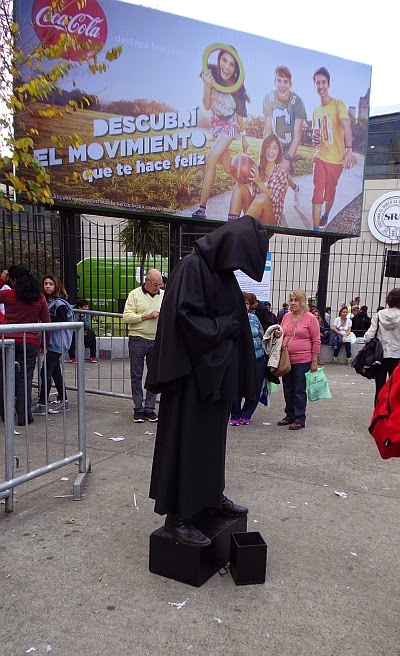
As we exited the fair, we saw a living statue working on the sidewalk. I don't know what his costume was supposed to represent—he was dressed completely in black—but although it had nothing to do with it, the background advertising banner (which was for something else entirely) fit the living statue's activity perfectly: "Discover the movement that makes you happy." And it was true: several kids went over to leave a coin in the box, and the statue would surprise them with a greeting.

Thus concludes the chronicle of this visit to the 2015 edition of the Livestock, Agriculture and Industry Exhibition at La Rural.

miércoles, 29 de julio de 2015

El Coleccionista de Libros.

El Coleccionista De Libros de Charlie Lovett.

(31 de Octubre, 2014). Me compré este libro, mi esposa lo había visto en la librería, me lo comentó, y cuando volvimos a visitar la librería ella se compró los suyos y yo me compré este, por curiosidad más que nada.
Tenía visiones algo encontradas, por un lado, porque en la tapa dice “Amor y obsesión se unen en una historia sobre el enigma de Shakespeare”. Al mismo tiempo en la contratapa dice “El coleccionista de libros es una original historia de misterio que nos lleva desde la actualidad hasta el mundo de Shakespeare, pasando por la Inglaterra del siglo XIX. Asimismo es un canto de amor a los libros destinados a hacer las delicias de todos los amantes de la lectura”.
Ahora bien, ¿de qué iba? ¿se trataba de una historia de amor o de una historia de misterio o de ambas entremezcladas? No soy muy afín a las historias estrictamente de amor pero sí a las de misterios. Bueno, solo quedaba indagarlo y la mejor manera era leer el libro. Es lo que hice.

El libro está escrito por Charlie Lovett. Lo desconocía como autor. Se trata de un escritor, profesor y dramaturgo norteamericano. Su página web es http://charlielovett.com/
Son 400 páginas. Traducción de Damiá Alou Remi. Y el título original es The Bookman´s Tales. Edición 2014. Publicado por Random House Mondadori S.A.
Tienen una página web que es http://www.megustaleer.com/

La tapa del libro en la parte superior muestra los ojos de una joven mujer (en la contratapa muestra los labios), luego casi en su totalidad lo que parece ser un papel viejo, manchado, y quemado. Y la parte inferior un viejo dibujo de una ciudad. Se trata de la ciudad de Londres, una vista decorativa publicada en 1751, titulada A General View of the City of London, next the River Thames / Vue Generale de la Ville de Londres, du cote de la Tamise. . . 

El libro está redactado en tres tiempos, en la época actual diríamos, cuando se desarrollan los sucesos, una época anterior de alrededor de diez años antes y una tercer época de acontecimientos sucedidos hace casi trescientos años antes, y este último período comienza a remontarse hasta la actualidad.
La etapa del noviazgo, yo diría, la etapa del romanticismo y la nostalgia, se vuelve algo melosa, pero es una opinión personal, son gustos.
La etapa del pasado está buena, pero adolece de descripciones, al menos a mi gusto, descripciones más generales y más particulares de la vida en aquella época.
Si se lee con detenimiento el libro es llevadero y hasta hay veces que deja con ganas de continuar, no me he podido aguantar y he dado saltos de capítulos para ver como continúa y luego regresar, continuar leyendo de manera lineal y releer la parte que había leído en el salto de capítulos.
Advierte e indaga en la vida de los coleccionistas de libros, pero no aquellos que coleccionar por coleccionar o que arman una colección en base a la sumatoria de libros, sino en los profesionales que buscan piezas raras, extrañas o de alto valor por la cualidad que sea. El mismo autor se reconoce como coleccionista especializado en Lewis Carroll. En la historia también toca el tema de los falsificadores, lo trata muy bien. Describe la vida por detrás de esta gente, aquello que no vemos, aquello que se va descubriendo con el tiempo, por ejemplo en base a investigaciones de otros estudiosos o entendidos. Abarca un período de tiempo que va entre los siglos XVII, XVIII y XIX.
La trama la mezcla con algo de amor, una o dos historias de amor. Y todo gira en el rastreo que hace de dos objetos, uno por un lado buscando descubrir un misterio sobre un libro, el otro sobre una pintura, y relata todo el camino de peripecias que va desentrañando a lo largo de cada página.

En cierta oportunidad hace mención a los “huevos benedictinos” y luego a la “risa sardónica”. Desconocía ambas expresiones. Y ahora buscando, las encontré.

Los Huevos Benedictinos, (en inglés Eggs Benedict) son un plato que consiste en dos mitades de un muffin, generalmente cubiertos con jamón cocido, beicon o pastrami, huevos escalfados y la muy popular salsa holandesa.
Existe un debate acerca de su origen, que puede leerse en el link.
http://es.wikipedia.org/wiki/Huevos_Benedict

Y sobre la Risa Sardónica: En medicina se dice que una persona sufre risa sardónica cuando presenta una convulsión y contracción de los músculos de la cara que imita la risa. En sentido figurado, se aplica la expresión al que disimula con risa falsa otros sentimientos. Para el Diccionario de Autoridades, la risa sardónica es una “enfermedad que se origina de comer o beber la hierba sardonia, especie de ranúnculo que perturba el sentido y retuerce los labios, causando un efecto que parece risa". Según otros autores, el adjetivo sardónico procede de Cerdeña. Al parecer, entre los bárbaros sardos, los hijos llevaban a los padres muy viejos a los montes para sacrificarlos entre fiestas y grandes risas.
http://www.muyinteresante.es/cultura/arte-cultura/articulo/ique-es-la-risa-sardonica

Debo confesar que llegando al final, el período actual del relato (recordemos que está redactado en tres períodos que se van intercalando), me atrapó, no tuve paciencia y lo leí de corrido saltado los otros dos períodos de tiempo, dejando estos dos últimos períodos para leerlo al final (aunque, al haber leído de esta manera, ya conocía el desenlace). Recomendado.

lunes, 27 de julio de 2015

The Stake Out

 The Stake Out. (002) This is the second episode of the first season of the TV series Seinfeld. “The Stake Out” could be translated as “El replanteo” [The Rethink], although it has also been translated as “De vigilancia” [On Surveillance] in reruns, and it is the second chapter of the sitcom Seinfeld.

Details:

Episode Summary:

During a party, Jerry flirts with a woman, but knows nothing about her except her workplace. Jerry is reluctant to find out her phone number through Elaine because he doesn’t talk about other women with her. Jerry’s father, Morty Seinfeld, suggests that he should wait outside the woman's building and pretend to run into her by accident. Jerry takes the idea and goes along with George. He manages to find the woman, whose name is Vanessa. The two then decide to go on a date.

Image 2 centered – Caption: The Stake Out.

In this chapter, The Stake Out (El replanteo or De vigilancia), Vanessa appears, played by Lynn Clark. Jerry meets Vanessa while attending a dinner party with Elaine. Jerry learns that she works at a law firm called "Simon, Bennett, Robbins, Oppenheim and Taft," and decides to show up to ask her out.

After dating for a short time, Jerry takes her to a bed and breakfast in Vermont, but rainy weather keeps them indoors and ruins the entire trip. Jerry should have listened to George, who discouraged the getaway weekend, calling it a “decathlon data.”

The first thing I must say about this chapter relates to the title The Stake Out, which translated would be something like El replanteo, and indeed it appears that way in some English commentaries. This stems from when Jerry "re-thinks" (se replantea) showing up at the woman's office to ask her out. The title of the chapter has also been translated as De vigilancia [On Surveillance], which is also valid, since Jerry and George station themselves at the entrance of the office building where the young woman works, and chat while conducting a sort of "surveillance" until they manage to see the girl appear. What I will never understand is why the DVD release translated the chapter as “La corrida de apuestas” [The Betting Run].

At the beginning of the episode, during a chat between Jerry and Elaine inside a video rental store—typical, quintessential local businesses of the 1990s—they first look at the movie Cocoon: The Return (1988), but put it down after making a joke about extraterrestres, and move on to make a "spicy" joke about an adult movie.

Right there, while both are in the video store, there is a callback to the previous episode (The Seinfeld Chronicles). In the video store, two older women walk past them; the older of the two says to the other: “When you’re dead, you’re dead. That’s it. Period.” And both (Jerry and Elaine) are left surprised.

In the previous episode, The Seinfeld Chronicles, at the laundromat, the following dialogue takes place between Jerry and George:

  • — Hey, your clothes must be done. Why don't you see if they're dry? (George)
  • — No, no, no. Don't interrupt the cycle. The machine is working and it knows what to do. Let it finish. (Jerry)
  • — You're gonna over-dry it. (George)
  • — You can't over-dry. (Jerry)
  • — Why not? (George)
  • — Same reason you can't over-wet. When something is wet, it's wet. It's like death. When you're dead, you're dead. Let's say you die, and I shoot you. You're not gonna die again. You're already dead. You can't over-die, you can't over-dry. (Jerry)

When they finish answering George, everyone else in the laundromat just stares at him in surprise.

At the birthday gathering of Elaine's friend, Jerry strikes up a conversation with another female guest, Vanessa, who says to him, "Why don't you relax and take your jacket off?" Jerry is wearing a colored shirt with a light brown jacket (windbreaker/blazer) over it. Jerry replies, "I can't, I get cold." Vanessa retorts mockingly, "How masculine of you." And Jerry adds, also mockingly, "Besides, I'm wearing short sleeves, I don't want to show off my tattoos." And the story goes on...

The question is: is it appropriate or not to take off a jacket, coat, or whatever you are wearing over a shirt? Is it appropriate or not? The premise is presented in a humorous way, true to the series. But at a formal gathering, is it appropriate or not?

To answer that, I found an answer on a protocol website's forum, which seemed the most appropriate to transcribe right here:

Dear Nati:

Although the custom you mention is widespread—not only at celebrations, but in business meetings and other settings—it is not correct to remain in what is known as "shirt sleeves."

The arguments you ask for: In England, at the end of the 19th century, the shirt was put on by pulling it over the head and was considered underwear; only the collar was visible, as other garments were worn on top. Later, it evolved into the button-down shirt.

Initially, shirts were white or very light shades, which meant distinction, since only the rich and wealthy could afford to wash them very often or change them frequently. When striped and checked fabrics emerged, many kept the white collar and cuffs to continue "marking" the class difference.

Therefore, among the Lords of England, it was considered bad manners to stay in just a shirt without wearing a jacket.

And that is where the custom of wearing a jacket with a shirt or sweater comes from; staying in just a shirt is likened to staying in underwear, to being a bit "undressed."

https://www.protocolo.org/foros/archivo/30956_quitarse_la_queta.html

Later in the episode, Jerry arrives at his apartment and finds that his parents have already arrived. His mother asks him where she is going to sleep, and that they are going to a hotel. Jerry tells them not to worry, to stay, and that he will go to his friend Kramer's place, who is also his neighbor.

  • — I'll sleep next door. (Jerry refers to Kramer's apartment)
  • — Doesn't Kramer mind? (his mother asks)
  • — No, he's making a bouillabaisse. (Jerry replies)

What is a bouillabaisse? Why does he mention it, or what is the point? What is relevant about Kramer making a bouillabaisse?

Bouillabaisse (from Provençal Occitan bolhabaissa, from bolh 'to boil' and, depending on the version, abaissa 'to lower the heat' or peis 'fish') consists of a soup of various fish, sometimes served whole. It is a traditional French dish from the Provence region, particularly the city of Marseille. It is very similar to the Portuguese Caldeirada. The soup is made from various rockfish such as: gobies, monkfish, conger eel tails, moray eels, red mullet, crabs, Norway lobsters, and anglerfish. It is very possible that the origin of this soup was a base derived from a stew made from the fish left at the bottom of fishermen's baskets.

https://es.wikipedia.org/wiki/Bullabesa

“Bouillabaisse, typical of the French Midi, is one of the most famous soups recorded in the history of gastronomy.” From the book Todo sobre las sopas by Yves de Saint-Pierre. Ediciones Gaviota, 1977.

However, according to another author, this soup is of Catalan origin (Suquet de peix), the recipe of which crossed the Pyrenees as early as the 19th century.

“Catalonia has its own complete cuisine just as it has a language. (...) Under the designation 'a la catalana' one finds in recipe books—not just regional, but Spanish or French—a hundred or more preparations of eggs, meats, vegetables, and legumes. It preserves ali-oli, which is common to all of Spanish Levante, Provence, Roussillon, and the islands of the western Mediterranean, and disputes Marseille and Genoa for the invention of seafood stews, such as bouillabaisse, which apart from the composition of the French name that predominated for its euphony and expression (bouillabaisse, that is, boil low; at the bottom), appears to be a Catalan-Spanish stew. Other Catalan dishes also crossed the border and became Provençal and French.” (pp. 165 and 166). From the book Guía del buen comer español by Dionisio Pérez Gutiérrez. Ediciones Maxtor, 1929.

This episode deals with the theme of friends, which is the overarching plotline, so to speak, throughout the entire series. It is something recurrent in 90s TV shows, not only in the US but also here in Argentina.

Other characteristics of the chapter are: Seinfeld's father is played by one actor, but was later replaced by a definitive one for the rest of the run. George's habit of lying is introduced; he fantasizes about being an architect, a theme he will pick up later as an unfulfilled dream or fantasy, but which he exercises through lying. This episode reveals the past romantic relationship between Jerry and Elaine, although they never say why they broke up (on the show's DVD, they joke about this). The plot idea for the script is based on real-life events that happened to writer Larry David, as he himself recounts on the DVD. The first reference to Superman appears (seen in the video store); Jerry is a comic book fan, with Superman being among them.

The girl who later enters a formal relationship with Jerry, Vanessa, is one of the few who continues as a girlfriend in other episodes. There are around 66 of Jerry's girlfriends counted throughout the entire run, but most last only the length of a single episode.

In the episode, George introduces the creation of his pseudonym, which will be “Art Vandelay”. He had suggested Burt Harb...inson, Burt Harbinson, Art Core, and Art Corevelay, but finally changes it and settles on “Art Vandelay”.

Here there seems to be a certain play on people's names; that is, starting from Jerry's chat with his father, the name of a real-life actress named Loni Anderson pops up, who in real life was married to an actor and comedian named Burt Leon Reynolds Jr. In the episode, during the chat between Jerry and George, they mention Loni Anderson just before George generates his pseudonym, and his first occurrence is Burt Harb...inson, Burt Harbinson.

I don't think it was a coincidence.

One of the comedic stretches in this chapter is based on the idea of a person suddenly, unexpectedly, and casually showing up in order to run into someone. It's nothing new, it's common, and almost childish, yet quite recurrent in social life, film, and television. It's hard not to know a case like this, and how ridiculous those who practice it look. In fact, they make this crystal clear through the mouth of Jerry's mother; she is the one who says that those who do it look ridiculous and act like fools.

A funny and well-executed visual gag is when George, chatting with Jerry while waiting in the elevator lobby, replies to Jerry's thank you for accompanying him with, “You're welcome. I was close by. Besides, did you think I was going to miss this? heheh.” Right there in his clownish pose, he raises his eyebrows and sticks out his tongue while smiling mischievously, letting out a bit of villainy in his attitude. It’s the same sadistic enjoyment of Commodus in the movie Gladiator (2000) when, being in the Roman circus, he sticks out his tongue while enjoying the gladiators' fight.

Later in the episode, Jerry and Elaine chat in Jerry's apartment. She tells him about her boyfriend, and Jerry asks, "What does he do for a living? What's his job?" She replies, "Wall Street." And Jerry remarks, "High finance. Speculation. Connecticut people."

I wondered why he said "Connecticut people"; it's hard to know unless you're familiar with things from up there. This saying comes from the simple reason that the State of Connecticut is a major hub for the insurance industry. The provision of financial and real estate services in that state is significant in volume. One of its cities, Hartford, is the state's financial center, being the largest hub for the insurance sector in the United States, and the second largest in the world (behind London).

That is the reason behind saying "Connecticut people."

In Inside Look on the show's DVD, writer Larry David talks at the end about the continuity of the characters' lives from episode to episode, discussing the advantages, except for those who haven't seen the previous episode.


Exposición de Ganadería, Agricultura e Industria.

Junto con mi padre asistimos a la Exposición de Ganadería, Agricultura e Industria del corriente año, también conocida como Exposición Rural Argentina o simplemente La Rural. No es la primera visita que realizamos, y la información sobre la misma que hay por la web es abundante. Para interiorizarse un tanto se pueden visitar los siguientes enlaces http://www.exposicionrural.com.ar/ y https://es.wikipedia.org/wiki/Exposici%C3%B3n_Rural_Argentina La Feria, este año, se lleva a cabo desde el 23 de julio al 2 de agosto del año 2015 en el horario de 9 a 20. Como es natural, hay dos costos para las entradas, los viernes, sábados y domingo las entradas cuestan más que el resto de la semana. Lunes y Martes gratis para jubilados. Por alguna razón extendieron esta motivación al día jueves, así es que hoy jueves 27 también fue gratis para jubilados. Y se llenó. Para el resto la entrada general, tenía un costo de 70 pesos. Eran alrededor de las 11am, y se había formado una fila muy larga, que llegaba al final de la calle, pero como está cortada, la extensión es de dos calles. Y lentamente avanzaba, pero era la fila de ingreso, para sacar la entrada, solo había que acercarse a las ventanillas y no había más que uno o dos antes de poder adquirirla. Iba rápido, pero luego el ingreso se ralentizaba. La inmensa mayoría eran jubilados, y había de toda clase de quejas, que no avanza, que falta de respeto, como le hacen eso a los viejos, etc… y un montón más entre aquellos que esperaban y avanzaban lentamente con aquellos venían buscando el final de la fila para sumarse a la misma. Un anciano atrás nuestro, con algo de soberbia le decía a otro menos mal que hoy es gratis, sino pa que vamos a venir, llevamos los pibes al campo, si total… ver unos animales, el otro anciano con el que conversaba le pregunta ¿a qué campo? Y este que rezongaba agrega a cualquiera. Al momento llega el hijo del primero y dice tuvimos que sacar tres generales, solo es gratis para menores de 8 y jubilados. No se lo escuchó decir nada más. Al llegar a la zona de las ventanillas, la fila se bifurca en dos partes, por una se separan los que poseen entrada general y por la otra continúan los jubilados gratis, y ahí estaba la razón de la demora, los jubilados mismos, a paso lento, y la dificultad para ingresar hacía la larga fila de espera, se trababan al pasar por entre los hierros separadores, cruzar el molinete, habían habilitado como tres pero eran insuficiente y esto sumado a la cantidad que pretendían entrar un mínimo amontonamiento llegados al ingreso.
Una vez ingresados, lleno de gente, así que comenzamos a recorrer. Y así lo hicimos recorriendo cada uno de los pabellones, no voy a comentarlos cada uno de ellos, pero sí subiré algunas fotografías de lo que uno iba encontrando.
De entrada pasamos directo al final, un camino recto que cruza todo el predio y nos lleva hasta el final, así lo hicimos con la idea de hacer un recorrido desde atrás hacia adelante. Así que llegamos al pabellón donde se encontraban las máquinas. El pabellón azul. Todo tipo de maquinarias. Este año hubo más de 4500 expositores de animales y más de 500 expositores comerciales.


Estas máquinas andan trabajando los campos. Muchas de ellas conocidas, más que nada en las zonas rurales. El característico “mosquito”, camión o tractor fumigador, común en los campos, sobre todo en plantaciones de soja, pero cuestionados por la utilización de los agroquímicos contaminantes y agresivos para el ser humanos, cuando su uso es cercano a zonas urbanas. Aquí, en el país,  también se le “mosquito” a los camiones que transportan autos, debido al existencia en el pasado de una empresa que así se llamaba “transporte el mosquito” , actualmente, el apodo se les da a estos tractores gigantes que despliegan las dos barras y de esta manera se asemejan a un moquito gigante metálico.
También se podía ver un silo, lo interesante, es que estaba cortado justo a la mitad, lo que permite observar su interior, para la gente de campo interesada en adquirirlo, pero para los más jóvenes y chicos como algo nuevo que se aprende.


Allí también había una gigantografía de una fotografía que había participado en un concurso fotográfico llamado “La vida en el campo con Mainero” organizado justamente por esta empresa. En otro stand, una réplica hecha a escala de la fragata argentina ARA Libertad botada en 1956.


Se pasaba al siguiente sector y este se componía una primera parte de productos alimenticios, y más adelantes talabarterías y accesorios, es en este sector que en la pared externa de uno de los puestos se encontraba el siguiente cuadro con una pintura en acrílico, titulada Araucanos, y firmada por Justo García Errecaborde según consignaba su certificado de autenticidad. Por lo que pude ver en la web, se trata de un pintor de temática costumbrista.


Llegamos al pabellón amarillo donde se concentraba todo el ganado vacuno, y allí todas las razas de estos animales. Luego de recorrerlo salimos y pasamos por la puerta que lleva al auditorio, del otro lado se encontraba la pista principal donde se estaban llenando las tribunas para presenciar el comienzo de un evento. Nosotros seguimos caminos e ingresamos al lugar donde se encontraban los caballos, gran parte de ellos, criollos.


Al salir de este sector de caballerizas, pasamos por la pista más pequeña. Allí pudimos ver una exhibición de caballos, que supongo, luego rematan al mejor postor. Al lado de esta pista más pequeña, otros gauchos esperando su turno para ingresar y mostrar sus correspondientes caballos.


Nuestro recorrido continuó por el área de demostración de camionetas 4 x 4. Útiles para las zonas de campo, por la facilidad para moverse en diversos tipos de terrenos, caminos que pueden presentar ciertas dificultades, aquí las empresas automotrices hacían demostraciones para el público asistente. Las personas que desean participar del recorrido, primeramente formaban una fila en la puerta que daba ingreso, luego por tandas iban pasando y bajaban una escalera. Allí abajo esperaban que llegue la 4 x 4 y subían tres o cuatro pasajeros, y luego el recorrido de la pista, pasaban por agua, por troncos inclinados, por una especie de sube y baja, y por una pendiente empinada ascenso y descenso. Y así sucesivamente vehículo tras vehículo.


Llegando casi al final del recorrido, no dejamos de pasar por el sector de aves. Allí bastante ajustado, pequeño en espacio, y con muchísima gente visitando, se hacía difícil recorrerlo con tranquilidad. Habían establecido una pequeña pileta de lona y ahí nadaban algunos patos. El resto de las aves las tenían cada una en su jaula. Dos tandas de pajareras se encargaban de tener a las aves más pequeñas. Mientras observaba una de las variedades de gallina, se me acerca una señor, y me pregunta ¿usted sabe que aves es esta?, le contesto No, y me dice – bueno, yo le voy a explicar, esta es una gallina de ... y siguió, cualquier inquietud que usted tenga habla conmigo. Bueno, muchas gracias y continuó mi camino, no hago dos pasos e interrumpe a otro visitante con la misma pregunta, y luego la explicación.


Luego un sector más alimenticio, mayormente quesos y embutidos, y algunos dulces. Después un sector con las representaciones de las provincias argentinas, donde se adquirían productos característicos del lugar que se trate, y finalmente el último sector de cabras y ovejas, llenísimo de gente. En nuestro caso lo dejamos para el final, pero la mayorías de las personas, era el primero pabellón que recorría por estar justo pegado a la entrada, de ahí que estaba repleto de visitantes.
Cuando salimos de la feria, vimos una estatua viviente trabajando allí en la vereda, no se que reflejaba con si disfraz, complemente vestido de negro, pero que si bien nada tiene que ver con esto, el cartel de publicidad de fondo (que tiene que ver con otra cosa) se puede aplicar perfectamente a la actividad de la estatua viviente, “descubrí el movimiento que te hace felíz” y así era, unos cuantos chicos iban a dejar su moneda en el cubículo y la estatua los sorprendía con una saludo.


Así concluye la crónica de esta visita a la Exposición de Ganadería, Agricultura e Industria edición del año 2015 en La Rural.

domingo, 26 de julio de 2015

The Book Collector

 The Book Collector – Charlie Lovett. (October 31, 2014). I bought this book; my wife had seen it at the bookstore and mentioned it to me. When we went back to the bookstore, she bought hers and I bought this one, out of curiosity more than anything else.

I had somewhat mixed feelings, on the one hand because the cover says, “Love and obsession unite in a story about the Shakespeare enigma.” At the same time, the back cover reads, “The Book Collector is an original mystery story that takes us from the present day to the world of Shakespeare, passing through 19th-century England. It is also an ode to books guaranteed to delight all lovers of reading.”

Now then, what was it about? Was it a love story, a mystery story, or a mix of both? I am not particularly fond of strictly romantic stories, but I do like mysteries. Well, there was only one way to find out, and the best way was to read the book. Which is what I did.

The book is written by Charlie Lovett. I was unfamiliar with him as an author. He is an American writer, teacher, and playwright. His website is charlielovett.com
It is 400 pages long. Translated by Damiá Alou Remi. The original title is The Bookman’s Tales. 2014 edition. Published by Random House Mondadori S.A.
They have a website which is www.megustaleer.com/

The top of the book cover shows the eyes of a young woman (the back cover shows her lips), followed almost entirely by what appears to be old, stained, and burned paper. The lower part features an old drawing of a city. It is the city of London, a decorative view published in 1751, titled A General View of the City of London, next the River Thames / Vue Generale de la Ville de Londres, du cote de la Tamise. . .

The book is written across three timelines: the present day, we might say, when the events take place; a previous period about ten years earlier; and a third period of events that happened almost three hundred years ago, with this last period eventually working its way back to the present.

The courtship phase—I would say the phase of romanticism and nostalgia—gets a bit syrupy, but that is a personal opinion; it's a matter of taste.

The past timeline is good, but it suffers from a lack of descriptions, at least to my taste—more general and specific descriptions of life in that era.

If read carefully, the book is engaging and at times leaves you wanting more. I couldn't help myself and skipped ahead across chapters to see what happens next, and then went back to continue reading linearly and reread the parts I had skipped over.

It explores and delves into the lives of book collectors—not those who collect just for the sake of it or build a collection simply by accumulating books, but professionals who seek rare, unusual, or high-value pieces for whatever reason. The author himself identifies as a collector specializing in Lewis Carroll. The story also touches on the subject of forgers, handling it very well. It describes the hidden lives of these people, things we don't see, and what gets uncovered over time, for instance through the research of other scholars or experts. It spans a period between the 17th, 18th, and 19th centuries.

The plot mixes in some romance, one or two love stories. Everything revolves around the tracking of two objects—one person trying to discover a mystery about a book, the other about a painting—and it chronicles all the twists and turns unraveled on every page.
At one point, it mentions “Eggs Benedict” and later “sardonic laughter.” I was unfamiliar with both expressions. Now, by searching, I have found them.

Eggs Benedict is a dish consisting of two halves of an English muffin, usually topped with boiled ham, bacon, or pastrami, poached eggs, and the very popular hollandaise sauce.
There is a debate about its origin, which can be read at this link: http://es.wikipedia.org/wiki/Huevos_Benedict

As for sardonic laughter: In medicine, a person is said to suffer from sardonic laughter when they experience a convulsion and contraction of the facial muscles that mimics a smile. In a figurative sense, the expression is applied to someone who masks other feelings with a fake smile. According to the Diccionario de Autoridades, sardonic laughter is "an illness originating from eating or drinking the sardonia herb, a species of buttercup that disturbs the senses and twists the lips, causing an effect that looks like laughter." According to other authors, the adjective sardonic comes from Sardinia. Apparently, among the ancient Sardinian barbarians, sons would take their elderly fathers to the mountains to sacrifice them amidst celebrations and great laughter. www.muyinteresante.es/cultura/arte-cultura/articulo/ique-es-la-risa-sardonica

I must confess that as I reached the end, the contemporary timeline of the story (remember it is written across three alternating periods) hooked me. I didn't have the patience and read it straight through, skipping the other two time periods and leaving those last two to read at the end (although, having read it this way, I already knew how it turned out).